
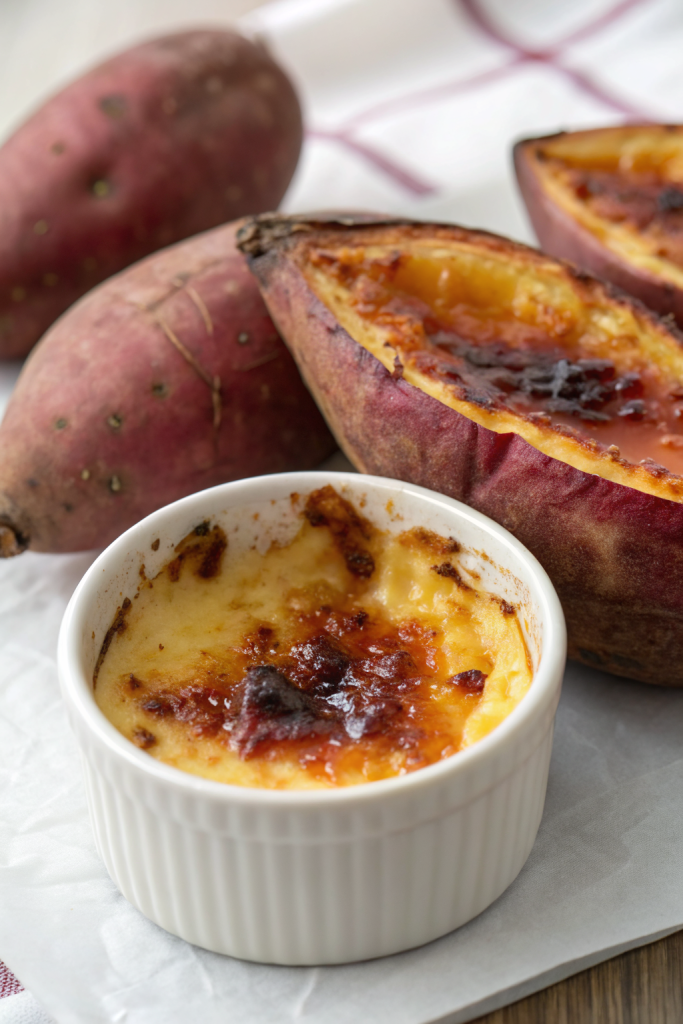
Japanese Sweet Potato Creme Brulee Recipe tastes like caramelized custard heaven with a cozy roasted sweet potato hug, and it works perfectly for anyone who loves classic creme brulee but wants a twist that feels a little more special in under about 1 hour total. This dessert suits dinner parties, date nights at home, or a solo “I deserve something fancy in my sweatpants” moment. I tested this version on my neighbors and they now “just happen” to walk by my house every time I roast Japanese sweet potatoes.
Why Make This Japanese Sweet Potato Creme Brulee Recipe at Home
Japanese sweet potatoes taste richer and nuttier than regular orange sweet potatoes, so the custard turns velvety, slightly earthy, and naturally sweet. You still get that crackly sugar top, but the base tastes deeper and more interesting than a standard vanilla custard.
You also control the sweetness, creaminess, and texture at home, which makes a big difference with creme brulee. This recipe uses simple ingredients, mostly pantry staples, and only needs basic equipment like ramekins and a baking dish.
“This Japanese Sweet Potato Creme Brulee Recipe tastes like a fancy restaurant dessert with cozy fall flavors, but it feels totally doable at home. ★★★★★”
Ingredients You Need
Japanese sweet potatoes
- 2 medium Japanese sweet potatoes
- Look for purple or reddish skin with pale yellow flesh.
- Choose firm potatoes with no soft spots.
- You can use regular orange sweet potatoes in a pinch, but the flavor turns less nutty and more earthy.
Dairy
- 2 cups heavy cream
- Use full fat heavy cream for the best texture.
- Avoid half and half, which can curdle and taste thin.
- 1 cup whole milk
- You can swap with more heavy cream for an extra rich custard.
- Avoid low fat milk, which weakens the custard.
Eggs and sugar
- 6 large egg yolks
- Use fresh eggs; older eggs can give the custard a slight sulfur note.
- Save the whites for meringues or omelets.
- 1/2 cup granulated sugar for the custard
- You can use organic cane sugar; it may give a slightly more caramel flavor.
- 1/4 to 1/3 cup granulated sugar for the topping
- Use regular white sugar; it melts and caramelizes evenly.
Flavorings
- 1 1/2 teaspoons pure vanilla extract
- Use real vanilla, not imitation, since the recipe uses so few ingredients.
- 1/4 teaspoon fine sea salt
- Salt sharpens the sweet potato and caramel notes.
- Optional warm spices
- 1/4 teaspoon ground cinnamon
- 1/8 teaspoon ground nutmeg
- 1/8 teaspoon ground ginger
- Use these lightly so they support the sweet potato flavor instead of overpowering it.
Pantry shortcuts and substitutions
- Use canned Japanese sweet potato puree if you find it at an Asian market.
- You need about 1 cup of smooth puree.
- Use vanilla bean paste instead of extract for visible specks and stronger aroma.
- Use light brown sugar for the topping if you like a deeper caramel crunch, but watch it closely since it burns faster.
Equipment list
- 4 to 6 ramekins, 4 to 6 ounce size
- Large baking dish or roasting pan that fits the ramekins
- Medium saucepan
- Mixing bowls
- Whisk
- Fine mesh strainer
- Blender or immersion blender
- Kitchen torch
- If you do not own a torch, use the broiler, but watch it closely.
- Kettle or pot to heat water for the water bath
- Baking sheet for moving ramekins in and out of the fridge
Tips & Mistakes
- Roast the Japanese sweet potatoes until very soft and caramelized at the edges for deeper flavor.
- Cool the roasted sweet potatoes before blending with eggs so you avoid scrambled egg bits.
- Blend the custard until completely smooth so the texture stays silky, not grainy.
- Strain the custard through a fine mesh sieve to catch any fibers or cooked egg specks.
- Use hot but not boiling cream when you mix it into the egg mixture to avoid curdling.
- Add the hot cream slowly while you whisk constantly so the yolks stay smooth.
- Use a water bath that reaches halfway up the ramekins so the custard cooks gently.
- Cool the custards completely before chilling so condensation does not drip onto the surface.
- Chill at least 4 hours, ideally overnight, so the custard sets and the flavors deepen.
- Sprinkle a thin, even layer of sugar on top; thick piles of sugar burn on the surface and stay raw underneath.
- Move the torch in circles and keep it a few inches away from the sugar so you caramelize, not scorch.
- Torch the custards just before serving so the sugar shell stays crisp.
- Use shallow, wide ramekins if you want more caramelized sugar in each bite and a shorter bake time.
- Avoid metal ramekins, which can heat too fast and overcook the edges.
How to Make Japanese Sweet Potato Creme Brulee Recipe
Step 1: Roast the Japanese sweet potatoes
- Heat the oven to 400°F.
- Wash and dry the Japanese sweet potatoes, then poke each potato a few times with a fork.
- Place the potatoes directly on the oven rack or on a lined baking sheet.
- Roast 45 to 60 minutes until very tender and a knife slides through with no resistance.
- Cool until you can handle them, then peel off the skins and discard them.
- Mash the flesh until smooth or blend it; measure out 1 cup of smooth sweet potato.
Step 2: Prepare the custard base
- In a medium saucepan, add the heavy cream and whole milk.
- Heat over medium until the mixture steams and small bubbles form around the edges; do not let it boil.
- In a mixing bowl, whisk the egg yolks, 1/2 cup sugar, vanilla, and salt until the mixture looks pale and slightly thick.
- Add the warm cream mixture slowly to the egg mixture while you whisk constantly.
- Whisk in the mashed or pureed Japanese sweet potato until fully combined.
- Use an immersion blender or regular blender to blend the mixture until completely smooth.
Step 3: Strain and set up the water bath
- Place a fine mesh strainer over a clean bowl or large measuring cup.
- Pour the custard mixture through the strainer and press gently with a spatula to push it through.
- Discard any fibers or bits left in the strainer.
- Arrange the ramekins in a large baking dish or roasting pan.
- Divide the custard evenly among the ramekins, leaving a little space at the top.
- Heat water in a kettle until very hot but not boiling.
Step 4: Bake the custards
- Move the baking dish with the filled ramekins to the oven rack.
- Carefully pour the hot water into the baking dish around the ramekins until the water reaches about halfway up their sides.
- Bake at 300°F for 30 to 45 minutes, depending on ramekin size.
- Check at 30 minutes; the edges should look set while the centers still jiggle gently when you nudge the ramekin.
- Remove the baking dish from the oven and lift the ramekins out of the water bath with tongs or a towel.
- Place the ramekins on a baking sheet or cooling rack and cool to room temperature.
Step 5: Chill the custards
- After the custards cool to room temperature, cover each ramekin with plastic wrap.
- Chill in the fridge at least 4 hours, or up to 2 days.
- The custard will firm up and the sweet potato flavor will meld with the vanilla.
- Keep the tops dry; if condensation forms on the plastic wrap, wipe it off so it does not drip onto the custard.
Step 6: Caramelize the sugar topping
- When you feel ready to serve, remove the ramekins from the fridge and pat the tops dry with a paper towel.
- Sprinkle about 1 to 1 1/2 teaspoons of granulated sugar evenly over each custard.
- Tilt and tap the ramekin so the sugar coats the surface in a thin, even layer.
- Use a kitchen torch to heat the sugar, moving the flame in small circles until the sugar melts, bubbles, and turns deep golden brown.
- Let the sugar cool 1 to 2 minutes so it hardens into a crisp shell.
- Serve right away so you get the contrast of cold custard and warm, crunchy caramel.
Broiler method if you do not own a torch
- Heat the broiler on high and move the oven rack to the top third.
- Place the chilled custards on a baking sheet and sprinkle the sugar on top as described above.
- Broil 2 to 5 minutes, watching constantly, until the sugar bubbles and browns.
- Rotate the tray as needed so the tops brown evenly.
- Cool a few minutes so the sugar hardens before serving.
Variations I’ve Tried
- Miso caramel version
- Whisk 1 teaspoon white miso into the warm cream before you add it to the eggs.
- The miso adds a subtle salty, savory note that pairs beautifully with the sweet potato and caramel top.
- Coconut milk twist
- Replace 1/2 cup of the heavy cream with full fat coconut milk.
- The custard picks up a gentle coconut aroma that works nicely with the natural sweetness of Japanese sweet potatoes.
- Spiced chai version
- Steep 2 chai tea bags in the warm cream and milk for 10 minutes, then remove the bags and proceed.
- Skip or reduce the extra spices so the chai flavor stays balanced.
- Matcha swirl
- Whisk 1 to 2 teaspoons matcha powder with a few tablespoons of the warm cream until smooth, then blend it into half of the custard.
- Layer plain sweet potato custard and matcha custard in the ramekins for a pretty two tone effect.
How to Serve Japanese Sweet Potato Creme Brulee
Serve this Japanese Sweet Potato Creme Brulee Recipe very cold with the sugar freshly caramelized so you get that perfect crack when you tap it with a spoon. Add a small dollop of lightly sweetened whipped cream or a spoonful of plain Greek yogurt on the side if you want a little contrast. Fresh berries like raspberries, sliced strawberries, or blueberries cut through the richness and add color. Pair it with hot green tea, roasted barley tea, or a simple cup of coffee for a cozy finish to any meal.
How to store
- Fridge
- Store the baked, cooled custards in the fridge, covered, for up to 2 days before you add the sugar topping.
- Keep them level so the custard sets evenly and does not slosh.
- After caramelizing
- Enjoy the caramelized creme brulee within 1 to 2 hours for the best sugar crunch.
- The sugar shell softens in the fridge, so torch just before serving when possible.
- Freezer
- Freeze the baked custards without the sugar topping for up to 1 month.
- Wrap each ramekin tightly in plastic, then in foil to prevent freezer odors.
- Thaw overnight in the fridge, then add sugar and torch before serving.
- Reheating
- Do not reheat the custard once it sets; serve it chilled.
- If the custard feels slightly too cold from the fridge, let it sit at room temperature 10 to 15 minutes before you add the sugar and torch.
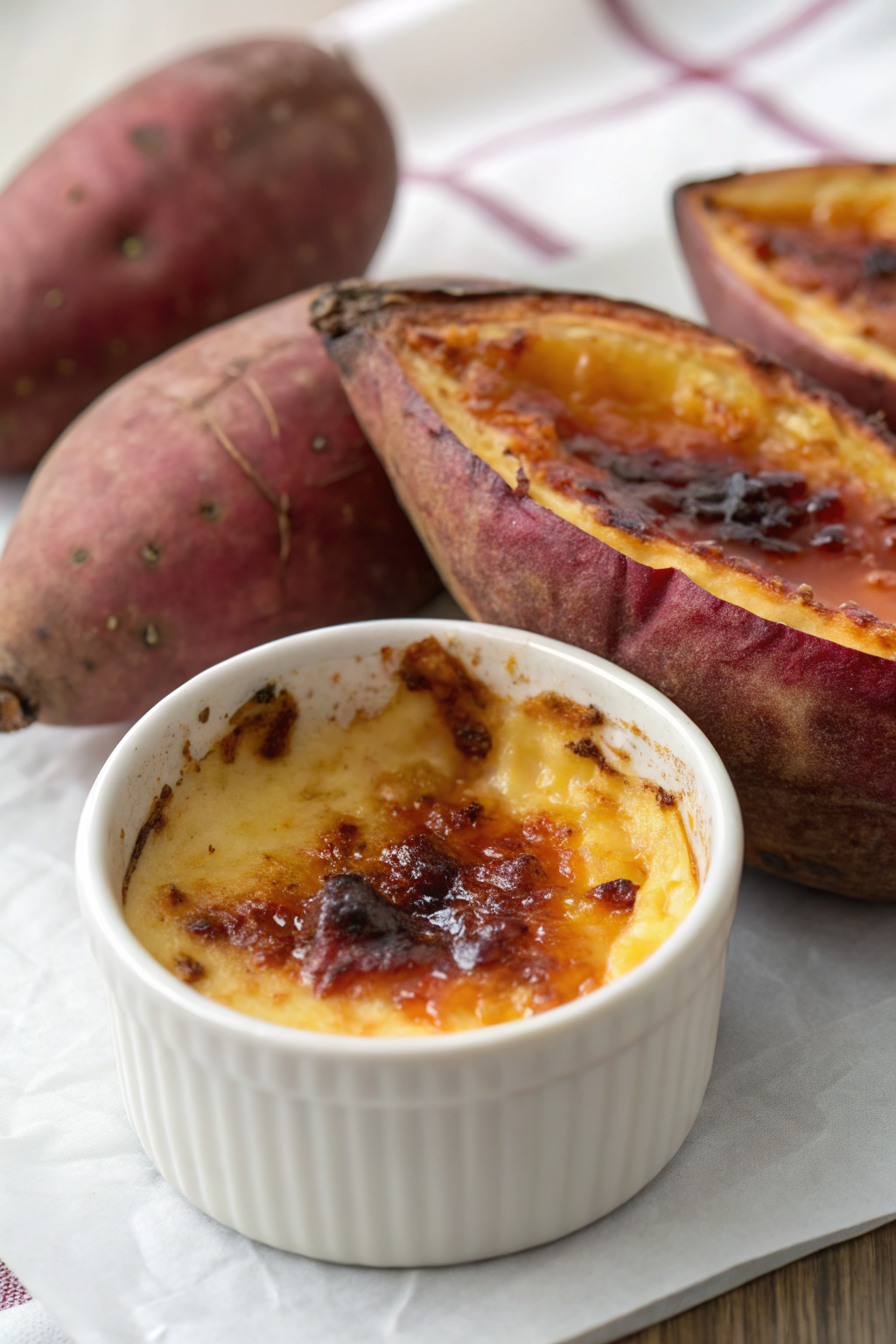
Japanese Sweet Potato Crème Brûlée
Ingredients
Method
- Preheat the oven to 300°F (150°C). Place 4 ramekins in a deep baking dish large enough to hold them in a single layer.
- Steam or boil the Japanese sweet potato cubes until very tender, 10–15 minutes. Drain well and let excess moisture evaporate.
- In a blender or food processor, combine the cooked sweet potato, heavy cream, whole milk, granulated sugar, brown sugar, vanilla, and salt. Blend until completely smooth and silky.
- In a mixing bowl, lightly whisk the egg yolks just to break them up. Slowly pour the sweet potato cream mixture into the yolks while whisking constantly, until fully combined.
- Strain the custard through a fine-mesh sieve into a measuring jug or bowl to remove any lumps and ensure a smooth texture.
- Divide the custard evenly among the ramekins. Skim off any foam from the surface with a spoon, if needed.
- Pour hot tap water into the baking dish to come about halfway up the sides of the ramekins, creating a water bath.
- Bake for 35–45 minutes, or until the edges are set but the centers still wobble slightly when gently shaken.
- Remove the ramekins from the water bath and let cool to room temperature. Then cover and chill in the refrigerator for at least 4 hours, or until fully set.
- Just before serving, sprinkle 1–1½ tablespoons of granulated sugar evenly over each custard. Use a kitchen torch to melt and caramelize the sugar until deep golden and crisp. Let the topping harden for 1–2 minutes, then serve.
Notes
Approximate per serving (1 of 4): 320 calories; fat 20 g; saturated fat 11 g; carbohydrates 30 g; fiber 1 g; sugars 26 g; protein 5 g; sodium 90 mg. Values are estimates and will vary based on specific ingredients, brands, and portion sizes.